
Public Wi-Fi may look connected while a captive portal blocks usable internet until sign-in completes. A travel eSIM can provide an alternative connection, but it does not guarantee that every website, VPN or payment service will work under all network conditions.
Who is this for?
A traveler checks into a hotel late at night. The Wi-Fi icon appears, yet the browser requires a room number and the corporate VPN never connects. Mobile data can help access support or retrieve the reservation, but consuming a limited GB balance for a huge software update is avoidable.
How to compare the available choices
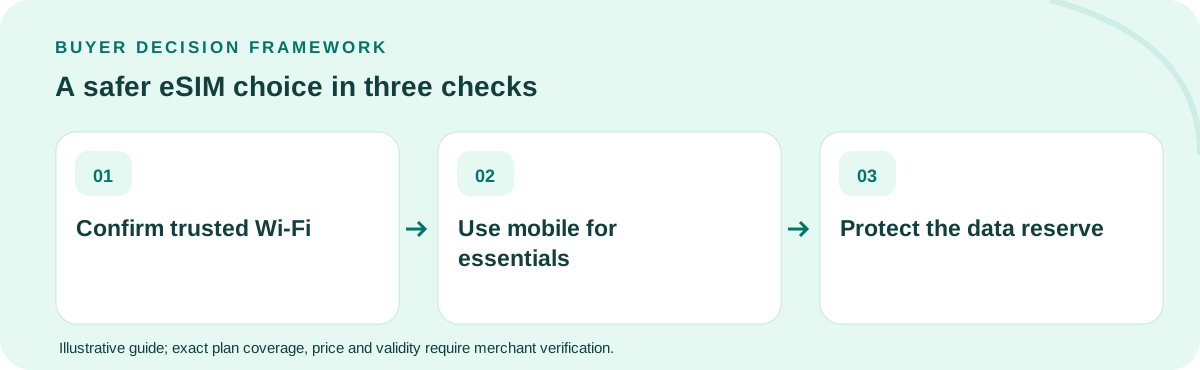
First determine whether the Wi-Fi itself is usable. Open an ordinary browser to trigger the portal, check that the network is genuinely connected, then consider whether an essential task must move to cellular data. Avoid entering credentials into suspicious look-alike portals; ask hotel staff for their official network details.
What to do before departure or purchase
For corporate work, verify VPN requirements with IT rather than assuming the eSIM is at fault. Some VPN or security services have device-management policies, and a phone hotspot may be a permitted backup only when the organization allows it. A second network is resilience, not a substitute for IT approval.
Worked example with explicit assumptions
Illustrative reserve: a traveler needs 300 MB for critical documents, 100 MB for communication and 400 MB for a brief meeting, totaling 800 MB. Keeping 1 GB unspent provides a buffer for a portal failure; actual consumption will vary by apps and media.
Common mistakes to avoid
The most common error is assuming a strong Wi-Fi signal means functional internet. Another is leaving a laptop uploading photos over hotspot after the hotel network recovers. Use metered settings and pause nonessential transfers to preserve your eSIM allowance.
What would change the answer?
When staying in a hotel, confirm the actual official Wi-Fi network name with staff before entering sign-in details. If the phone redirects to an unfamiliar page, do not assume the network is safe. Use the travel eSIM for sensitive tasks when the Wi-Fi cannot be trusted, and return to regular Wi-Fi only after confirming the portal and any required VPN policy.
Five-item decision worksheet
| Check | What to verify |
|---|---|
| Eligibility | Confirm the exact device, activation method and covered destination(s) against the retail product, not a country-average study. |
| Validity | Work backward from the situation described in this guide: A traveler checks into a hotel late at night. Check when the clock starts and the last active day. |
| Usage | Estimate the full-speed GB or communication capabilities this particular itinerary needs; include hotspots, essential apps and an emergency buffer. |
| Economics | Compare current final payable totals only among options that meet every requirement; treat any arithmetic example here as hypothetical. |
| Fallback | Before departure, consider this failure mode: The most common error is assuming a strong Wi-Fi signal means functional internet. Keep the seller’s support instructions available offline. |
Which option should you buy?
Use the eSIM for tasks that cannot wait, then return to trusted Wi-Fi when it works. Evaluate a plan by usable reserve and tethering policy as well as sticker price, and confirm the current retail terms before paying.
Can a travel eSIM fix every hotel Wi-Fi login problem?
It can offer an independent data path, but it cannot resolve a defective VPN policy or guarantee that a service will work on every network.
Primary technical/regulatory reference: official guidance for this topic. This source provides background, not a verification of any live TripoSIM SKU. The scenarios, prices and quantities in this guide are illustrations, not tested carrier offers. Every product's eligibility, data, voice, coverage, activation, fair use and current final price must be checked with the seller before purchase.
Ownership: This website is commercially affiliated with TripoSIM. It does not claim independent testing, neutrality or live catalog pricing. See research methodology.