
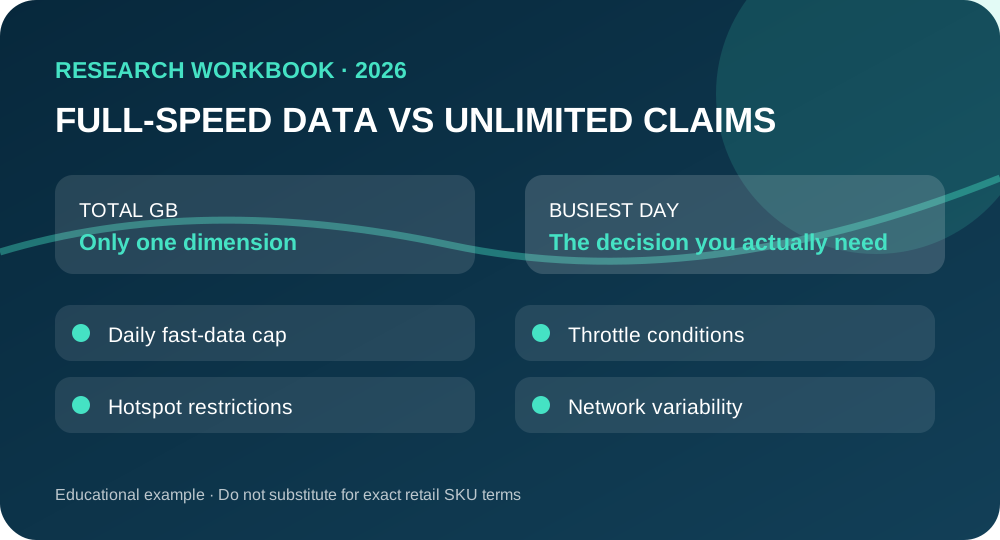
“Unlimited” does not tell you how fast tomorrow’s call will be.
A plan may permit unlimited total transferred data while restricting how much is available at full speed each day. This practical guide turns fair-use clauses, device behavior and a realistic workload into a more reliable purchase decision.
Separate total data, high-speed data and usable performance
For fixed-GB plans the first limit is usually a finite total allowance. For products marketed as unlimited, the relevant variables may include a daily high-speed allowance, a reduced speed after the threshold, network management, and hotspot restrictions. All four need to be read from the actual SKU, because a country-level list of possible plan attributes cannot establish the terms of the specific product you buy.
Theoretical bandwidth is not the same as application performance. A quoted reduced-speed limit of 500 kbps is approximately 0.5 megabits per second in ideal arithmetic; real throughput also depends on coverage, congestion, latency, protocol overhead and routing. That is why it would be misleading to guarantee that a given video service works or fails purely from a throttle number.
Our dated research snapshot contains daily-fullspeed-cap observations for 189 destinations, with a median of 1024 MB. Those observations describe fields in one archived supplier dataset, not a measured result for every network or a current public promise. A purchaser should consult the plan’s own current fair-use disclosure.
A data budget that reflects how phones really behave
Begin with activities, not the vague category “heavy user.” Maps, text messaging and occasional browsing can be relatively light, while an operating-system update, photo backup, cloud drive sync or tethered laptop can move gigabytes without obvious user action. Check the handset’s per-app cellular counters before travel and review settings for automatic app updates and cloud uploads.
A hypothetical two-week itinerary might require 0.3 GB/day for navigation and messaging (4.2 GB), four half-gigabyte photo-upload days (2 GB), and three remote-work sessions at 1.2 GB each (3.6 GB). The resulting base estimate is 9.8 GB before a safety margin. A 10 GB pack could be tight; a larger valid fixed allowance or a suitable high-speed unlimited product may be safer. Actual consumption varies materially with device and application settings.
For a household using one hotspot, multiply by the number of concurrently connected devices only where each device is expected to consume data. Do not blindly multiply the entire phone budget: the aim is to estimate workloads by device and avoid double counting.
Daily high-speed limits versus a single fixed allowance
A 14 GB fixed allowance over seven days permits very uneven use: the traveler might consume 5 GB on the arrival day and very little the next. A high-speed “2 GB per day” product allocates speed differently. The total headline allowance could look similar over seven days, but the daily cap can be a problem on a day with large uploads or long calls, while idle days may not compensate.
Test against your busiest day, not merely the trip average. For example, if a laptop requires 3.5 GB on one day and the product offers 1 GB of daily high-speed data before throttling, that day has a 2.5 GB high-speed shortfall. The total transferred data may still be technically unlimited, but the working experience could differ from what the buyer expects.
Determine whether the daily counter resets at local midnight, a network-defined cycle, or 24-hour windows. If the merchant does not publish that detail, record it as unknown rather than inventing it.
Hotspots create hidden demand and battery risk
A laptop connected to a phone hotspot may perform backups, software updates, security scans and background sync automatically. The handset’s data counter records the traffic, not its business value. Before departure, use the computer’s metered-network settings if available, pause unnecessary uploads and download large documents over trusted Wi-Fi.
Hotspot support is a plan-level term, not a guarantee of the device’s technical ability. Some offers permit tethering freely, some restrict it, and others may have separate limits. Verify the exact conditions for the chosen SKU. A buyer should also consider heat and battery drain during long calls: using a hotspot continuously can exhaust the phone long before the purchased allowance is consumed.
If a work trip depends on reliable connectivity, have a backup connection and use Wi-Fi for non-sensitive large transfers when appropriate. A phone’s signal indicator is not a quality-of-service guarantee.

What 5G labels and country network counts actually mean
A country page may list multiple observed operators and a 5G availability flag in a source dataset. That does not mean every retail plan connects to each operator, or that 5G is available along every route. Network selection also depends on roaming agreements, device-supported bands, location, cell capacity and the selected SKU.
The archived 198-destination table includes 5G indicators in 100 country entries. That is evidence about fields in a specific source, not proof of live 5G access or performance. A better buyer question is: “Which networks does the exact plan list, and what fallback service can I expect in the places I will actually visit?”
When no reliable measurement exists for a mountain road, an airport hall or a remote hotel, say so. A photograph of a signal icon is not a speed test. Firsthand tests should include method, device, location, date and repeatability before being used to support a performance claim.
Three practical travel profiles and the different best answers
The light traveler relies on messaging, occasional maps and offline downloads. A small fixed allowance may be cost-efficient if the trip fits its duration. The content creator uploads hundreds of photographs, streams and shares video. Their decision depends on total GB, upload requirements, daily cap and the reliability of backup networks. The remote worker needs the highest confidence during a few important calls, even if total monthly data is modest.
Consider a seven-day remote-work itinerary with three critical call days at 1.6 GB each and four sightseeing days at 0.25 GB, totaling 5.8 GB. A valid 10 GB fixed plan may serve the arithmetic better than a daily-capped unlimited product; alternatively, a generous daily full-speed cap may work well. Check hotspot restrictions and prioritize an alternate connection for mission-critical calls.
An unlimited label is not an objective quality ranking. The right plan is the one whose specific terms accommodate the peaks in your expected usage.
The final technical decision checklist
Record the destination and exact plan scope, validity, full-speed rules, any daily reset, hotspot policy, network list if disclosed, top-up method, install/activation trigger and total price. If any term is missing, ask the seller before relying on the plan for work or essential navigation. Never interpret the word “5G” as a minimum-speed promise.
Our comparison tools use user-entered and dated source values. The research is owned within the TripoSIM commercial group, and the final purchase takes place on TripoSIM. We do not claim independent multi-provider coverage or guaranteed speed tests; we provide a transparent decision method that visitors can audit.
Make the decision with your actual trip details
Use the esimdatadeals decision tools
The seller’s current SKU terms always determine eligibility and the final payable price.
Open the decision lab →Compare your trip requirements →Check TripoSIM plans ↗Sources and editorial limits
Official references used for general legal, platform, or technical context:
Country-level TripoSIM figures are an archived supplier snapshot covering 198 destinations. They are not current checkout offers, independent carrier measurements, or guarantees of plan-specific validity, networks, or performance. This website is commercially affiliated with TripoSIM. Updated retail eligibility and final price must be checked on the seller’s current offer.
Turn this research into a buying checklist
Use the eligibility calculator to organize your requirements before opening TripoSIM. Check exact coverage, price and validity at the merchant.
Calculate your next step →Commercial affiliation: this website and TripoSIM are part of the same business network.